Month: March 2026

AI Proficiency: A Baseline Skill

On February 13th, the U.S. Department of Labor (DOL) released a national AI Literacy Framework. This voluntary blueprint is designed to prepare the American workforce for AI-enabled work, signaling a shift where digital proficiency is no longer an elective—it is a baseline requirement. For business leadership, the framework clarifies that literacy is defined not by the software you purchase, but by how your team is prepared to interact with it.

At the center of this new standard is Prompt Engineering. It is the critical skill that bridges the “Execution Gap” between having an AI tool and realizing verifiable mastery in a corporate environment.

Defining Literacy Through the DOL Lens

The DOL Framework defines AI literacy as a cohesive system of understanding how AI works, how to use it safely, and how to supervise its output. In high-stakes professions, this requires moving beyond “AI curiosity” toward Applied Workflows. Prompt engineering is the language of this interaction. It allows an attorney to move from generic summaries to generating high-fidelity, industry-specific work products that meet the company’s rigorous standards.

Moving Beyond "Software Instruction" to Verified Readiness

Fulfilling the DOL’s mandate requires more than giving a workforce a login; it requires a strategic partnership that builds human infrastructure. This is where our team of training experts jumps in alongside your team to operationalize every step of the national blueprint.

Rather than offering generic “how-to” sessions, we act as a fractional extension of your company, integrating directly into your strategy to deliver customized training for every AI tool in your stack.

How our experts equip a ready workforce:

  • AI Adoption Strategy Consulting: Change management and planning to guide implementation, including sponsor enablement (leadership alignment), communications strategy, learning plans, support structures, and success metrics.
  • Responsible & Effective Use of AI: A foundational session covering AI principles, approved tools and policies, responsible use, and how to evaluate and verify AI outputs.
  • AI Tool Training: Hands-on, in-context training that helps professionals apply approved AI tools in their real workflows while maintaining company standards.
  • Prompting for Better Results: Practical prompt engineering that teaches participants to set clear goals, provide context and sources, define expectations, and use repeatable frameworks and techniques to direct AI effectively and reduce rework.
  • Validating AI Output: A risk-based approach to supervising AI output—how to classify what AI produced, spot common failure modes, and apply practical validation moves.
  • AI Innovation Labs & Continuous Reinforcement: Facilitated workshops to explore and prioritize industry and department-specific AI use cases, supported by webinars, job aids, and self-paced resources that create an ongoing pathway for continued learning as tools evolve.

The Three Pillars of Modern AI Proficiency

To meet the national standard, an effective educational roadmap must focus on three domains:

  1. Critical Interaction (The Art of the Prompt): Mastering techniques that reduce “hallucinations” and ensure output is anchored in approved data.
  2. Strategic Supervision: Moving from passive acceptance of AI output to active, expert oversight and verification.
  3. Role-Based Application: Ensuring senior partners, associates, and staff master the specific prompting skills required for their actual day-to-day workflows.

A Call to Capability

The DOL AI Literacy Framework is a call to action to treat digital proficiency as a core capability, not a default skill set. By focusing on prompt engineering excellence, businesses can reclaim billable capacity, mitigate risk, and sustain a culture where professionals lead with technology rather than reacting to it.

At Alterity, we don’t just teach; we build the strategic roadmaps that turn innovation into a competitive advantage.
Get started today!

About the Author
About the Author

Carolyn Humpherys

Senior Consultant

Carolyn is a Senior Consultant with over 20 years of experience. Her expertise in communications, facilitation, technical training, change management, and graphic design, coupled with three decades of experience in the legal industry, positions her as a highly skilled and leading consultant. Utilizing established methodologies in adult learning, change management, and evaluation, Carolyn assists firms in educating people and elevating performance. Her expertise is highly sought after by organizations looking for genuine transformation as they adapt to modern work practices.

Carolyn has an interdisciplinary degree in Organizational Communications, Graphic Design and Writing. Her professional certifications include: Prosci® Change Management; Kirkpatrick Four Levels® of Evaluation; ATD Consulting and Human Performance; and the University of Oklahoma Training & Development Program. A life-long learner, Carolyn dedicates time to researching and learning new technologies. Since the release of ChatGPT, her focus has included the responsible and effective use of Generative AI tools. Co-recipient of the ILTA 2016 Consultant of the Year award for her role in creating the Traveling Coaches Certified Legal Trainer Program, Carolyn has helped over 150 law firm trainers elevate their performance.

Carolyn collaborates closely with clients to craft strategies for a wide range of adoption initiatives such as cloud technologies like NetDocuments, iManage Work, Microsoft 365, Teams and Copilot; compliance topics like Security Awareness and AI usage; and organizational topics such as thriving cultures and information governance. Her focus is on crafting solutions that address the challenges that impact people and the organization.
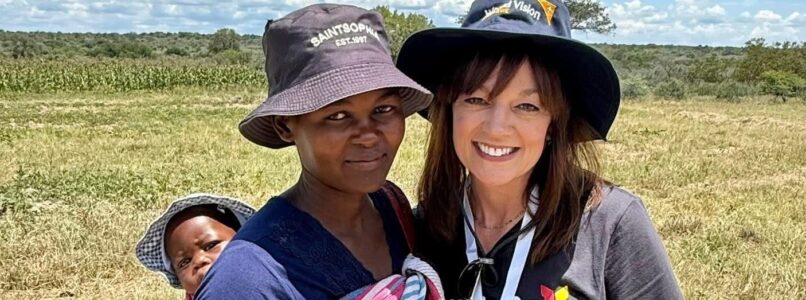
Strong Women Transforming Communities: Reflections from Zimbabwe

Some trips inform you. Others change you.

My recent visit to Zimbabwe with World Vision’s Strong Women, Strong World Beyond Access program did the latter. What I saw was not simply a development program at work. I saw women gaining confidence, families becoming stronger, and communities beginning to reshape their future.

One local leader described the journey in a way that stayed with me:
“We were gender aware. Then we became gender sensitive. Now we are gender intentional.”

That shift in thinking is changing lives.

Starting With Women

The Beyond Access approach places women and girls at the center of development while building on World Vision’s work in clean water access and economic empowerment. As infrastructure projects bring clean water closer to communities, training begins immediately. Couples participate in Biblically Empowered Worldview and gender equality training. Women take part in leadership development and economic empowerment programs that teach practical skills for generating income. By the time water arrives, something important has already taken root. Mindsets begin to shift.

Women who once believed their opportunities were limited start to say:

“I can.”

Soon after, they begin to say:

“I have.”

Confidence grows. Skills develop. Opportunity follows.

When Women Are Equipped, Families Change

One woman shared a statement that has stayed with me:

“I am no longer a beggar to my husband.”

Income changes relationships. Through savings groups, small business training, and collective enterprises, women begin contributing financially to their households. As that happens, tension within families often decreases and partnership grows.

The women also spoke openly about their hopes for their children:

  • Educating them
  • Keeping girls in school
  • Giving daughters the skills to build businesses of their own

Their vision for the future reaches far beyond themselves.

A Garden That Changed Everything

During our visit we returned to the Wilikisa Simanyene Nutrition Garden, a project we first saw in its early stages the year before. Today the 3.7 hectare garden is thriving and managed by 24 women and 3 men. With fencing, irrigation, and clean water made possible through World Vision’s work, the garden produces green peppers, tomatoes, sweet potatoes, beets, maize, sugar beans, and carrots. The harvest feeds families and generates income from surplus produce.

For many members, this is the first reliable income they have ever earned. Yet the impact reaches far beyond finances. Before water access, women and girls walked long distances to fetch water several times each day. These trips were exhausting and sometimes dangerous. Today clean water is within 50 to 100 meters of their homes. That single change has freed time and energy that can now be invested in farming, businesses, and family life.

Faith’s Story

One of the women I met was Faith, a 27 year old mother of two young children. Before water access, daily life was difficult. She carried the responsibility of collecting water and firewood while caring for her children and managing the home. Fetching water required long walks to the river, sometimes through areas where hyenas roamed. Today the water source is less than 100 meters from her home. That change opened new possibilities. Faith joined the community savings group and began contributing regularly. After a year she used her savings and interest to purchase a donkey, which she now uses to plow the garden.

Income from the garden and her clothing resale business allows her to:

  • Pay school fees for her daughter
  • Support household needs
  • Invest in additional inventory for her small business

Faith now serves as secretary of the garden group, a leadership role she once would not have imagined pursuing. She also shared something deeply personal. Before the program, needing to ask her husband for money often created tension. Now she contributes financially to the household. Her husband helps fetch water. Their relationship has improved. Her progress has strengthened her entire family.

Women Lifting Others

What stood out most during our visit was the spirit of collaboration among these women. The garden group shared that one of their future goals is to support people in their community living with disabilities. Their desire is not only to succeed themselves but to help others succeed as well.

Many members have also started additional income generating activities such as:

  • Baking and selling bread
  • Running small shops
  • Buying and reselling clothing
  • Selling cell phone minutes
  • Raising livestock

One lesson they emphasized repeatedly is the importance of multiple sources of income. Diversifying income creates stability. Only a few years ago many of these women had no income of their own. Today they manage savings groups, businesses, and agricultural projects together. Working collectively has strengthened what each individual woman can accomplish.

Clean Water Opens the Door

During the trip we also witnessed the drilling of a borehole that will bring clean water to another community. Access to water changes daily life in immediate and lasting ways.

When water is close to home:

  • Girls stay in school instead of spending hours collecting water
  • Women have time to pursue income generating activities
  • Gardens produce food throughout the year
  • Household nutrition improves
  • Families grow stronger

Clean water creates the foundation for opportunity.

A Moment I Will Never Forget

One of the most meaningful moments of the trip was meeting Begazella, the six year old girl my family sponsors through World Vision. She greeted me with confidence and joy and recited a poem she had prepared. Together we planted a tree and named it Joy. In just a short time she filled my heart with exactly that.

Child sponsorship is deeply personal. It is more than providing support from afar. It is choosing to walk alongside a child as they grow, learn, and discover who they can become. Begazella reminded me why this work matters.

A Future Already Taking Shape

The women I met in Zimbabwe are not waiting for change to arrive. They are creating it.

Women who once had no income now run businesses.
Women who once lacked confidence now lead community initiatives.
Families are stronger. Children are in school. Communities are moving forward.

Their determination is changing what is possible for the next generation.

Join Me in This Work

Ending extreme poverty is possible. But it requires people who are willing to step in and help create opportunity. Programs like World Vision Strong Women, Strong World Beyond Access demonstrate what happens when women gain access to training, leadership development, and essential resources like clean water.

Women rise.
Families stabilize.
Communities grow stronger.

You can be part of that transformation. Sponsor a child.  Support clean water initiatives.
Invest in programs that equip women to build businesses and lead in their communities.

Every step forward begins with someone choosing to care. After seeing this work firsthand, I am convinced of something simple and powerful.

When women are empowered, entire communities rise.

About the Author
the Author

Gina Buser

CEO and Founder

Gina Buser is the CEO and Founder of Alterity, an education and talent development consultancy headquartered in Dallas, Texas. Under her visionary leadership, Traveling Coaches has become a trusted partner for law firms worldwide, empowering and educating talent, implementing large technology initiatives, managing change, and influencing behavior. In 2019, Gina expanded her vision by founding Alterity Solutions, a sister company aimed at serving additional verticals. Their mission is to empower and educate individuals, elevate clients through engaged and thriving employees, and ensure that everyone wins.